
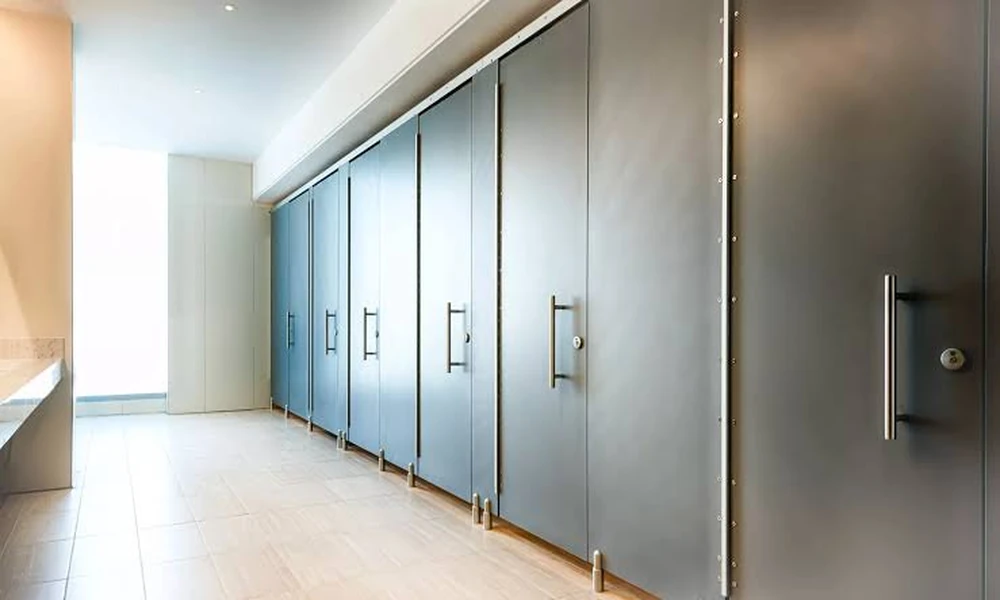
European-style restroom compartments have moved from boutique hotels into offices, airports, and mixed-use towers across North America. These systems replace the familiar overhead-braced metal stall with full-looking cubicles, flush doors, and minimal visible hardware. The shift reflects how much weight occupants now place on restroom design as part of the overall building experience.
What defines a European-style compartment?
A European-style compartment is defined by flush construction and a cleaner silhouette. Doors and pilasters meet in a flush, rebated closure rather than overlapping, panels often run closer to the floor and ceiling, and visible gaps are minimized. The look reads as built-in millwork rather than a stall system.
What standards apply to the panel material?
Compact phenolic panels used in these systems are a form of high-pressure laminate. In Europe, these laminates are classified under a common standard for high-pressure decorative laminates (European Committee for Standardization), while North American projects commonly reference a national standard for the same product family (National Electrical Manufacturers Association).
How are manufacturers adapting the format for North American projects?
Manufacturers are adapting the format with dedicated collections. Some European-style lines use 13mm phenolic panels described as nonporous, water-resistant, and impact and scratch resistant, mounted on Type 304 stainless steel pedestals with self-closing doors that meet pilasters in a flush, rebated finish (ASI Global Partitions). Collections differ mainly in head rail profile and bracket design.
Why does a 13mm panel matter?
A 13mm panel matters because compact phenolic achieves rigidity without a separate core or edge banding. That allows thinner, cleaner profiles than many traditional partition constructions while keeping strength and moisture resistance.
What do pedestal heights change?
Pedestal heights change the visual weight of the compartment and the clearance for floor cleaning. Lower pedestals bring panels closer to the floor for a more enclosed feel, while taller pedestals leave more room for mops and machines.
Where are European-style compartments gaining ground?
European-style compartments are gaining ground wherever restroom quality affects how a property is perceived. Hospitality is a clear example, with United States hotel occupancy averaging about 63 percent in 2023 (STR). Owners competing for guests treat public restrooms in lobbies and meeting spaces as a direct reflection of the brand.
Which other building types are adopting the format?
Several building types are following hospitality’s lead:
- Class A office towers competing for tenants
- Airports investing in passenger experience
- Corporate headquarters and amenity-rich workplaces
- Restaurants, theaters, and premium retail
What should designers evaluate before specifying?
Designers should evaluate occupancy indicators, latch hardware, and emergency access along with appearance. Flush doors look best when hardware is concealed, but operations teams still need clear occupancy signals and a reliable way to open a door from outside. Reviewing these details with facility managers prevents a beautiful compartment from becoming an operational headache.
How does maintenance compare?
Maintenance is generally straightforward because compact phenolic tolerates water and routine cleaning well. Teams should still confirm hinge adjustment procedures and replacement part availability before committing a large project to a new system.
How do European-style compartments handle privacy?
European-style compartments handle privacy through construction rather than add-ons. Flush, rebated door closures eliminate the straight-through sightlines common in traditional stalls, and some collections describe their doors and pilasters as delivering zero sightlines. Combined with taller panels, the result is a compartment that feels closer to a private room than a stall.
How do head rail and bracket choices affect the look?
Head rail and bracket choices define the character of each collection. Octagonal or tubular head rails, along with aluminum or stainless brackets supporting pilasters from above, let designers select a profile that matches the surrounding architecture and hardware finishes.
What is the takeaway for North American projects?
European-style compartments bring a residential, millwork-like quality to commercial restrooms. Projects that pair 13mm phenolic panels with stainless pedestals and thoughtful hardware achieve that look while keeping the durability public restrooms demand.

Dorothy Thomas is an interior décor enthusiast and design writer who explores modern styling ideas, home aesthetics, and space transformation techniques. Her work highlights practical décor concepts that help homeowners create stylish, functional, and visually appealing living spaces.
