
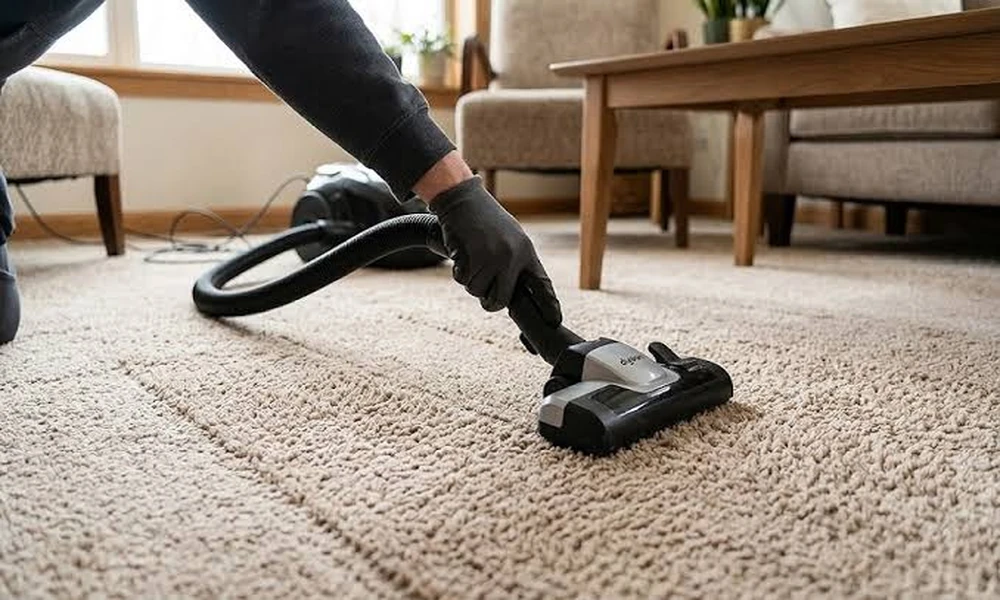
Loose fluff after a carpet installation does not automatically mean the floor needs a deep clean. Some early shedding can be an ordinary characteristic, while an attached yarn or a changing patch may deserve retailer advice. Identify what you are observing before renting an extractor specifically to make the fibres stop appearing.
A new carpet invites close inspection. Its owner may notice every strand in a vacuum container and worry that the floor is gradually being removed. That concern is understandable, but the amount of fluffy material collected is not a diagnosis. Start with the product’s care guidance and the condition of the carpet itself.
Loose fluff and an attached yarn are different observations
The Carpet and Rug Institute’s installation guidance describes shedding of loose fibres as normal and says it should diminish with regular vacuuming. It separately discusses a tuft projecting above the surface and cautions against pulling it. Those are different observations, even though both may be described casually as loose carpet fibres.
When contacting a retailer, describe whether the material is lying freely on the surface or still attached to the carpet. State whether there is a particular location involved. A general account of scattered fluff differs from a report that yarn is emerging repeatedly from one join or that a local patch is changing.
Do not test the distinction by tugging at the carpet. An attempt to discover whether a strand is loose can become the cause of further damage. Leave attached material alone and ask for product-specific advice. A close photograph taken without disturbing the area is usually a more useful starting point than a handful of deliberately pulled fibres.
Nor should one reassuring description settle every concern. The fact that ordinary shedding exists does not prove that a particular defect is harmless. If the surface develops a visible gap, thinning area or another unexpected change, have it assessed rather than extending a general explanation beyond the evidence.
Let the product’s early-care instructions lead
Find the care information for the installed carpet, including any vacuum requirements. A familiar household vacuum may need a different setting or attachment for the new floor. Ask the retailer when the instructions are unclear. The objective is suitable routine care, not the strongest possible agitation in an effort to remove all loose material immediately.
A vacuum that catches or becomes difficult to move should not be forced across the surface. Resolve whether the equipment and settings suit the carpet before continuing. The experience with the old floor is not necessarily a guide to the new one, even if both look like ordinary fitted carpet.
Follow the vacuum’s own maintenance requirements too. Emptying or replacing its collection container as instructed helps keep the observation consistent. A neglected tool and an unsuitable head can complicate the picture, leaving the homeowner unsure whether the concern comes from the carpet, the cleaning method or the equipment’s condition.
Allow the retailer to explain what is expected for the particular product. Do not impose a universal deadline for shedding to end based on an unrelated carpet online. The useful information is whether the observed pattern fits this installation and whether any change needs further attention.
Give a separate spill its own decision
A new carpet can have loose fibres and also receive an ordinary spill. The spill should be considered on its own facts, with the appropriate care instructions. It should not become evidence that shedding needs wet treatment, nor should an explanation about shedding be used to ignore a real stain or other incident.
For an Aurora household with an independently established cleaning need, the Aurora carpet-extractor page provides rental information to discuss after the permitted method is known. Tell the provider that the carpet is newly installed and describe any retailer guidance. A machine hire should serve the approved cleaning task, not an unsupported plan to wash away a carpet characteristic.
If the product’s instructions require a particular professional process, follow that requirement instead of assuming a rental gives an equivalent result. A person using the equipment also needs to understand the method and the material. Access to a machine does not settle every condition attached to caring for a new floor.
Keep the purpose narrow enough to evaluate. Removing ordinary soil according to an approved process is a meaningful objective. Guaranteeing that no fibre will ever appear again is a different promise, and one that a routine extraction booking cannot establish simply through more passes or more solution.
Watch the carpet rather than the size of the fluff pile
A collection of airy fibres can look more dramatic than its significance to the installed surface. Instead of judging by the pile in the bin alone, observe whether the carpet’s appearance is stable under ordinary use. Report changes in a specific area to the retailer, without attempting to diagnose the construction from collected material.
If an assessment is needed, provide the installation date, product details and the care already performed. These details help the retailer ask relevant questions. A short factual account is enough; there is no need to invent a daily measurement system or retain every vacuum bag in the absence of a request.
Continue only with care that is appropriate for the floor and any advice received. Repeated intensive treatment undertaken to relieve anxiety can obscure the original observation. The aim is to maintain the carpet while clarifying the concern, not to produce a completely empty vacuum container as proof that the problem has disappeared.
A new floor is best judged as an installed surface with its own characteristics and care requirements. Loose fluff may belong to normal early use; a changing or damaged area deserves attention. Separating those possibilities keeps a routine maintenance decision from becoming an unnecessary wet-cleaning experiment.
