
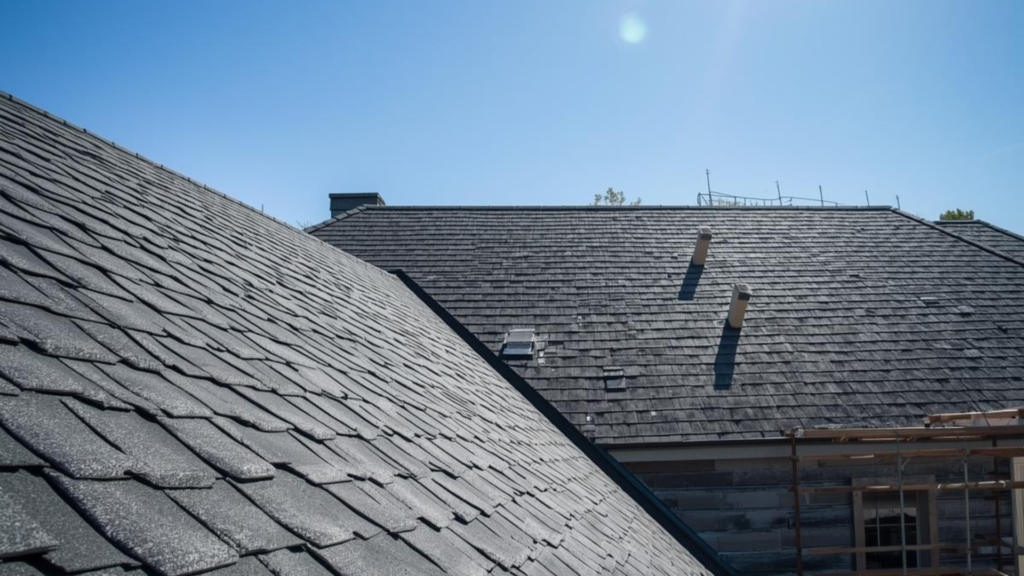
Most homeowners do not wake up excited to plan a new roof. If your shingles are still “mostly there” and the leak is not actively dripping into a bucket, it is tempting to push the decision out. One more season feels reasonable. One more season also has a way of turning a manageable project into a bigger repair bill, a longer scope of work, and a lot more stress.
If you are on the fence about roof replacement, this article is not here to scare you into a quick sale. It is here to explain, in plain language, what changes when a roof is already near the end of its service life and you decide to wait through another cycle of heat, wind, rain, and freeze.
The hidden problem with “it’s not leaking much”
A roof rarely goes from “fine” to “disaster” overnight. Most failures are progressive. Materials lose flexibility, fasteners loosen, seals shrink, and vulnerable transitions around vents and flashing age out. When the roof is already tired, a normal season of weather can push it past the point where repairs stay small.
The tricky part is that interior symptoms usually show up late. By the time you see a ceiling stain, peeling paint, musty smells, or a damp corner of insulation, the roof has often been letting moisture in for a while. Water does not always travel straight down. It can follow rafters, run along decking seams, or drip behind walls before it ever announces itself in a visible way.
What “one more season” can do to a failing roof
1) Small openings become pathways for widespread moisture
A single lifted shingle tab, a tiny crack in a pipe boot, or a compromised flashing edge can let water in during specific wind-driven storms. Waiting does not just mean “more chances to leak.” It means more time for water to move.
Once moisture reaches the roof deck (the wood layer under shingles), it can start softening the wood fibers. The deck may not look dramatic from the outside, but it can lose strength, warp, or delaminate. That matters because a roof system relies on solid decking to hold nails, maintain alignment, and resist wind uplift. If the deck weakens, you can end up replacing sections of wood you would not have needed to touch if the roof had been replaced earlier.
2) Repairs become less effective, even if they are done correctly
Early in a roof’s life, a targeted repair can be a great solution. Near the end of its life, repairs often become short-term patches because the surrounding materials are brittle and worn.
Example: replacing a few shingles sounds simple. But if the adjacent shingles crack when lifted, or if the underlayment beneath is degraded, that “small repair” can turn into a bigger area. The goal shifts from “restore performance” to “buy time,” and buying time can be expensive if it has to happen repeatedly.
3) The attic and insulation take the hit first
When moisture enters a roof system, insulation is usually the first casualty. Wet insulation loses effectiveness and can hold moisture against framing. Even if the roof leak is eventually fixed, insulation may need to be removed and replaced.
There is also the comfort factor. A roof that is letting moisture in is often also allowing conditioned air to escape through gaps and deteriorated areas. Homeowners sometimes notice a spike in heating or cooling usage before they ever notice a drip. Waiting a season can mean paying for energy loss you cannot easily see.
4) Mold risk and indoor air quality concerns increase
Not every leak leads to mold, and “mold” does not automatically mean a worst-case scenario. Still, moisture plus organic material (wood, paper facing on insulation, dust) creates the conditions mold needs. The longer moisture is present, the more likely it becomes that you will have to address not just the roof, but also cleanup.
This is one of the biggest “cost multipliers” of waiting. A roof replacement is a planned construction project. Moisture remediation is a different category of work, often with different trades and different levels of disruption.
5) Flashing and penetrations become the weak link
Many leaks do not start in the middle of a roof field. They start at transitions:
- Chimneys
- Plumbing vents
- Roof-to-wall connections
- Skylights
- Valleys
- Dormers
- Step flashing and counterflashing details
These areas handle movement, temperature swings, and water concentration. When the roof covering is aged, those components may be aged too. Waiting through another season increases the odds that one of these points fails and causes a leak that is harder to trace and more likely to wet structural areas.
6) Wind damage escalates quickly on brittle shingles
Aging shingles lose granules and become less flexible. That makes them more likely to crack or tear in high winds. It also makes them harder to repair cleanly because lifting them can break them.
The “one more season” gamble often fails here: a roof that might have survived mild weather can be pushed over the edge by a single wind event. The result is not always a dramatic blow-off. It can be a pattern of lifted tabs, broken seal strips, and fastener issues that lead to multiple leaks across different locations.
7) Ice and freeze-thaw cycles expose weaknesses
In climates with freezing temperatures, a roof at the end of its life is more vulnerable to freeze-thaw stress. Water gets into tiny gaps, freezes, expands, and widens the opening. Repeated cycles can turn hairline issues into larger failures. That is why some homeowners make it through fall “just fine” and then hit problems in late winter or early spring.
Even if you never see a classic ice dam, freeze-thaw action can still affect flashing edges, sealants, and vulnerable roof details.
The financial side: how waiting changes the scope
It is easy to think of a roof as one line item. In reality, the longer you wait, the more likely it becomes that you are paying for additional categories of work that have nothing to do with the shingles themselves.
Here are common “scope expanders” that show up after a roof has been failing for a while:
- Decking replacement due to soft spots or rot
- Fascia or soffit repairs where water has run behind edges
- Insulation replacement after repeated moisture exposure
- Drywall repairs and repainting where stains appear
- Trim repairs around roof-to-wall areas
- Mold mitigation in attic spaces or wall cavities
- Gutter and drainage adjustments if water has been overwhelming edges
The frustrating part is that these costs often feel unrelated to the roof decision, even though they are downstream effects of delaying it.
How to tell if you are in the “waiting is risky” zone
Not every aging roof needs immediate replacement. The key is to identify whether your roof is still in a repair-friendly stage or whether it is entering the stage where the odds of compounding damage rise.
Consider replacement timing more seriously if you notice several of the following:
Exterior signs
- Shingles that look curled, cracked, or unusually brittle
- Widespread granule loss (not just a small patch)
- Multiple exposed nails or frequent nail pops
- Sagging areas or uneven roof lines
- Repeated issues in the same zone after prior repairs
- Flashing that appears lifted, rusted, or separated
Interior and attic signs
- Water stains that “come and go” depending on weather
- Damp insulation, compressed insulation, or a musty attic smell
- Visible darkening on roof decking (especially around penetrations)
- Signs of moisture near chimneys, vents, or skylights
- Bathroom fans or dryer vents that terminate improperly and contribute to moisture buildup (this is not a roofing defect, but it can accelerate problems)
“Pattern” signs
- You have fixed more than one leak in the last couple of years
- Repairs are becoming more frequent or spreading to new locations
- Storms cause new issues each season
- You keep hearing “it will buy you some time” instead of “this should solve it”
When the pattern shifts toward repeated issues, waiting tends to be a losing bet.
The seasonal trap: why timing feels logical but can be costly
Homeowners often delay because they want to “get through” a season. Common versions of this include:
- “Let’s get through winter.”
- “Let’s get through the rainy season.”
- “Let’s wait until after we host family.”
- “Let’s wait until next year when the budget is better.”
Those reasons are understandable. The catch is that the roof does not pause. If your roof is already in a vulnerable state, the season you are trying to get through might be the exact season that exposes the weakness.
A more practical approach is to think in terms of risk management:
- If your roof is stable and a repair truly restores performance, waiting can be fine.
- If your roof is showing multiple end-of-life symptoms, waiting is not neutral. It increases risk, and risk has a cost.
If you are not ready to replace today, do this instead of hoping
Sometimes replacement timing is constrained by finances, scheduling, or other life priorities. If you need time, you can still reduce the odds of “one more season” turning into serious damage.
- Get a thorough evaluation focused on failure points. Ask specifically about flashing, penetrations, valleys, roof-to-wall transitions, and ventilation. Many leaks live there.
- Address active leaks immediately. Even if you plan to replace later, stop water intrusion now. Water damage is what expands scope.
- Ask whether a repair is restorative or temporary. A good professional should be able to tell you if a repair is likely to hold for years or if it is a short-term bridge.
- Monitor the attic after major weather. You do not need to obsess, but checking after heavy rain or wind events can catch problems early.
- Plan replacement before the roof forces your hand. A planned project gives you control over timing, product selection, and contractor availability. An emergency often removes those advantages.
The bottom line
Waiting one more season can be perfectly reasonable if your roof is still structurally sound and a targeted repair truly restores performance. But when a roof is already at the edge, “one more season” is not just time passing. It is additional cycles of stress that can turn small vulnerabilities into moisture damage, insulation problems, deck replacement, and interior repairs.
The smartest roof replacement timing is usually not “as soon as you feel nervous.” It is “before repeated failures start compounding.” If you suspect you are close to that line, the best next step is to get clear on your roof’s condition and what the realistic outcomes are if you delay.
